



What type of content boosts your visibility in AI Overviews?
Since Google launched AI Overviews, one question keeps coming up among SEO professionals: how do you get your content to appear in these new AI-powered results?
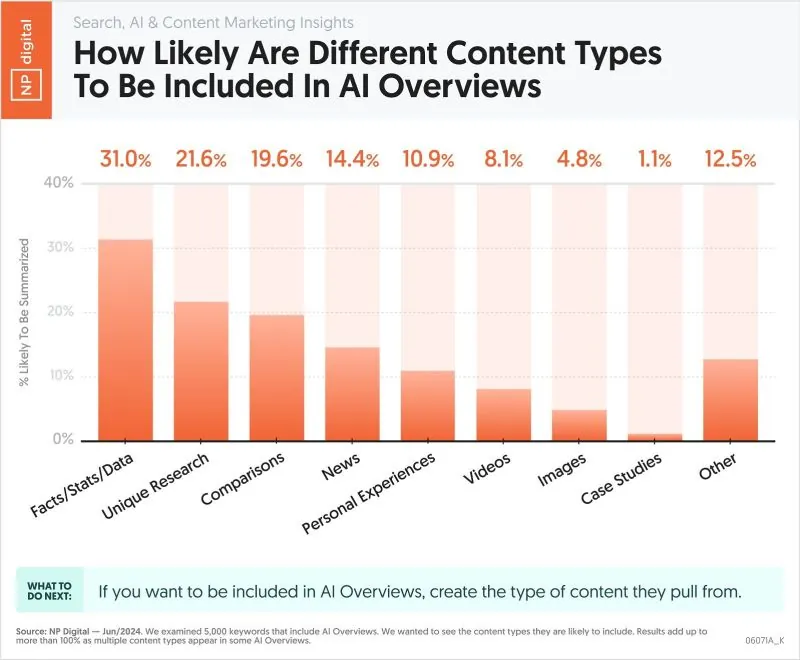
According to a recent analysis by Neil Patel, a well-known marketing expert, certain types of content are more likely to show up in AI Overviews summaries. The main ones are:
- Well-structured, clear, and concise information
- Factual content and statistical data
- Informative content that prioritizes freshness and novelty
- Detailed and explicit comparisons
- Keywords aligned with search intent
Source: Neil Patel
In other words, classic SEO practices are still relevant. But it is now essential to write answer-oriented content that is clear, useful, and well-structured. FAQs, lists, and simple definitions are especially effective.
ChatGPT, Perplexity, Google: which platform is leading today?
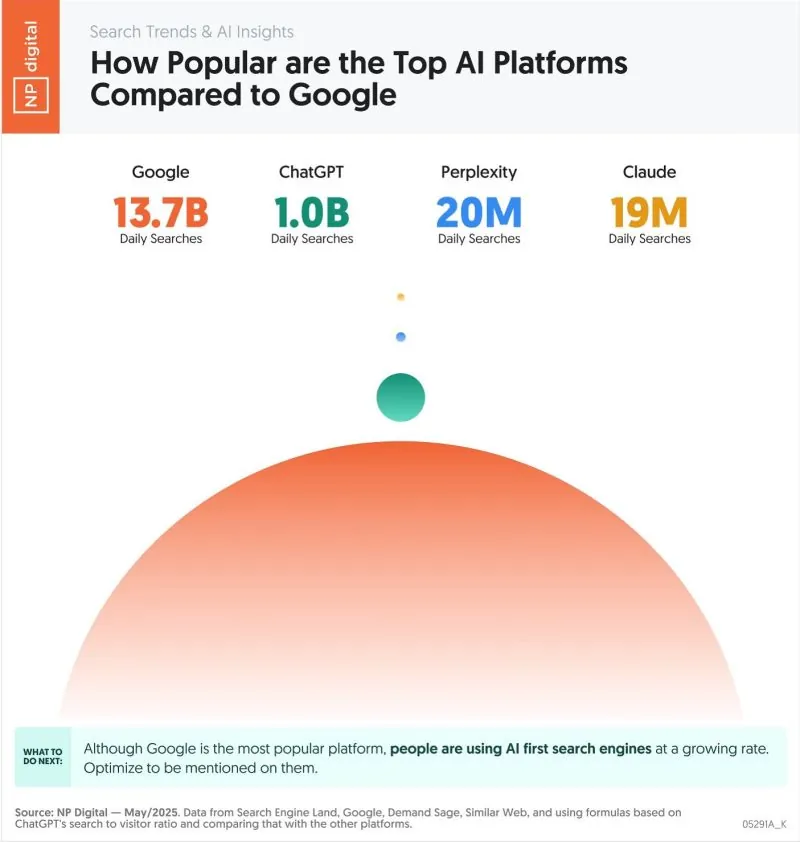
Google still leads the pack in online search, with 13.7 billion daily queries. But other players are gaining ground and need to be factored into any content optimization strategy.
AI-powered search engines like ChatGPT and Perplexity are gaining significant traction thanks to their advanced conversational capabilities. These tools are built on LLMs (Large Language Models), AI programs that understand and generate human-like text by drawing on existing knowledge. According to a recent Neil Patel post, here is the current popularity breakdown of the main search platforms:
- Google remains the top choice for accessing information online.
- ChatGPT is increasingly used for complex queries, thanks to its continuous learning from feedback, web browsing capabilities, and personalized responses through conversation memory.
- Perplexity is also an AI-powered conversational search engine, and it is growing steadily, especially among professionals looking for direct answers backed by credible sources.
Source: Neil Patel
This shift in search behavior signals a real change in how people find information. For marketers, it means adapting content not just for Google, but also for conversational search engines that reward clarity, authority, and conciseness. These are growing fast, and a new set of optimization practices known as GEO is becoming essential to complement traditional SEO.
GEO (Generative Engine Optimization): why it matters and how to do it
Generative Engine Optimization (GEO) is about improving a brand's visibility in AI-powered search engines like ChatGPT, Perplexity, and Google AI Overviews. An analysis of 10 million citations by the Profound team (August 2024 to June 2025) showed that the most-cited sources vary widely by platform. A one-size-fits-all strategy simply will not cut it anymore.
Here is what the data shows:
- Perplexity heavily favors Reddit content (46.7% of citations), followed by YouTube videos (13.9%).
- ChatGPT cites Wikipedia first (47.9%), followed by Reddit (11.3%) and B2B sources like G2, Forbes, and TechRadar.
- Google AI Overviews shows a more balanced mix: Reddit (21%), YouTube (18.8%), Quora (14.3%), and LinkedIn (13%).

To maximize your presence across these platforms, it is worth tailoring your channels, formats, and content for each one.
Here are the practical recommendations:
For Perplexity:
- Post actively in relevant subreddits.
- Create short-form video content (YouTube Shorts, TikTok, Reels).
- Encourage community managers to engage and reply on Reddit.
- Experiment with longer-form video (5 to 15 minutes) in a podcast-style format.
For ChatGPT:
- Make sure your Wikipedia page is complete, credible, and up to date.
- Invest in PR efforts to get featured in traditional publications (Forbes, Business Insider).
- Do not overlook Reddit. It remains an important secondary source. Contribute with helpful, informative replies in your field and add links to your site where relevant and useful.
For Google AI Overviews:
- Stay active on Reddit (again!).
- Publish well-optimized YouTube videos.
- Build expert-level content on LinkedIn (thought leadership, employee-generated content).
- Actively respond on Quora with thorough, helpful answers.
Bottom line: a strong GEO strategy requires a targeted presence on third-party platforms, paired with useful, community-driven, multi-format content. It is a good opportunity to rethink your online presence and move beyond the old mindset that SEO means organic results in Google only.
TikTok: Trump grants a new 75-day extension in the US

As the TikTok debate continues, Donald Trump recently signaled support for a new 75-day extension giving the company more time to complete the sale of its US operations.
This additional runway pushes back the ban threat and gives brands a welcome window to keep running campaigns on the platform. That said, the ongoing uncertainty is a reminder of why depending on a single advertising channel is risky. Diversifying your content strategy and marketing investments remains critical.