


Advertising on Pinterest lets an SMB reach people in purchase-planning mode, with some of the lowest entry costs among the major platforms. A campaign that converts rests on three pillars: properly configured tracking, a simple audience structure and a Pin that makes people want to click. Here is how to build that structure with less than $100 a day.
Pinterest, a visual search engine with purchase intent
Pinterest behaves more like a visual search engine than a classic social network. People come to plan a concrete project: a renovation, a trip, a meal, a seasonal wardrobe, a style idea, a new decor. This planning mindset changes everything for an advertiser, because the person is already projecting toward a future purchase.
Key statistic: 97% of searches on Pinterest are unbranded, which means people are looking for ideas and products rather than a specific brand. Source: Pinterest Advertising Costs 2026, January 2026 benchmarks, checkthat.ai.
What sets Pinterest apart from Meta and Google
The three platforms capture different intents, which explains their gaps in costs and conversion pace.
- Meta (Facebook and Instagram) interrupts a person in a social content feed. Purchase intent is created on the spot, from the creative.
- Google responds to an intent expressed at the precise moment the user types their query. The click is expensive because the demand is immediate.
- Pinterest captures discovery and planning intent. The cycle is longer, often 21 to 30 days, in exchange for much cheaper clicks.
Who is the platform best suited for?
Advertising on Pinterest delivers its best results for companies whose product tells its story in images. Retail, home decor, fashion, beauty, food, travel and direct-to-consumer brands find natural ground there.
Watch out: Pinterest is less suited to very niche business-to-business services, urgent purchases and finance, where the cost per conversion climbs ($12 to $15) for a low conversion rate. In those cases, Google captures immediate intent more directly. Source: How Much Do Pinterest Ads Cost, 2026, mbadv.agency.
The architecture of a Pinterest ad account
A Pinterest campaign is built on three nested levels. Understanding the role of each one avoids scattering a small budget and makes every dollar measurable.
Campaign, ad group, sponsored Pin: who does what?
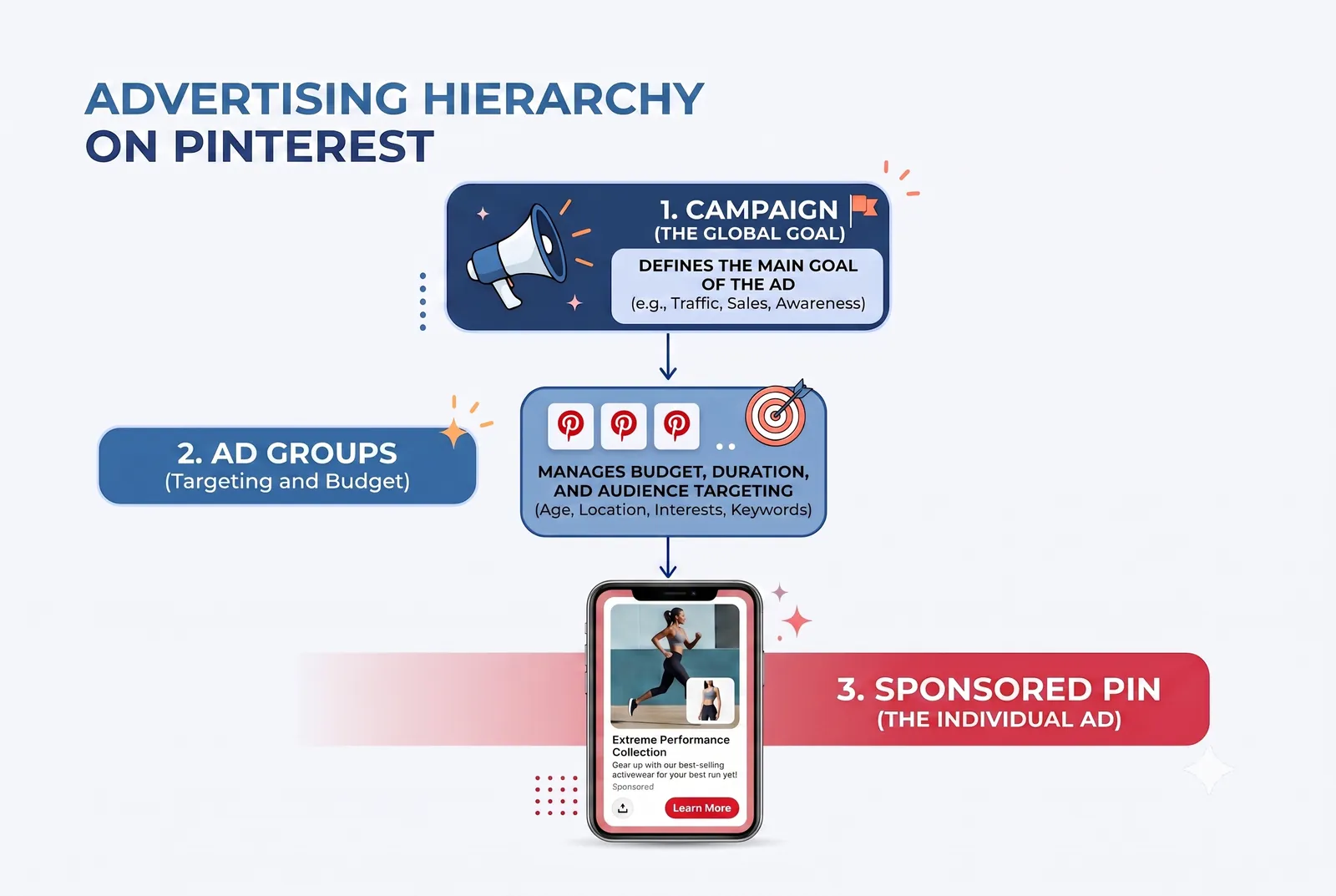
- The campaign carries the marketing objective and the overall budget. It is the level where you decide what you are trying to get: awareness, traffic or sales.
- The ad group brings together targeting, daily budget, schedule and bids. It is the real steering level of delivery.
- The sponsored Pin is the creative visible to the audience. A Pin is a saveable vertical image; a sponsored Pin is that same format, delivered as paid advertising.
Choosing the right objective when conversion is the goal
Pinterest bills differently depending on the chosen objective, and this choice determines who the platform shows your Pins to. Aligning the objective with your true commercial intent remains the most profitable decision of the whole setup.
- Awareness: billed by CPM, to maximize reach. Useful upstream, poorly suited to direct sales.
- Consideration and traffic: billed by CPC, to bring qualified visitors to your site.
- Conversions and catalog sales: billing geared to cost per action, so Pinterest looks for people ready to buy.
Pinterest ad formats, explained simply
Pinterest offers several ad formats. For an SMB getting started, knowing the role of each one helps you choose, then start with the simplest.
We recommend starting with the standard Pin: it is the fastest format to produce and the cheapest to test. An online store with a product feed benefits from activating catalog ads from the start, letting Pinterest automatically serve the right products to the right people.
Structuring a Pinterest campaign that converts, step by step
A simple, well-tracked structure beats a complex, poorly measured one. Here is the method we apply for a tight budget.
Set up tracking before spending the first dollar
The Pinterest tag, a short piece of code installed on your site, records visitor actions: page views, add-to-carts, purchases. Without it, the platform delivers blindly and you cannot optimize toward conversion.
We complement the tag with Pinterest's Conversions API, which makes data reporting more reliable despite browser blocking. The official documentation details the setup step by step: Pinterest Business help center.
This technical step often slows down teams that are just starting. Our performance measurement offer covers exactly this setup: tag implementation, conversion event configuration and validation in Google Tag Manager. We support companies so tracking is reliable before the first dollar is spent.
Watch out: Check that each conversion tag fires exactly once. A tag that fires twice artificially inflates your results and skews optimization, as we frequently observe during technical audits.
A simple audience structure for a small budget
The classic temptation is to multiply ad groups. With less than $100 a day, this fragmentation prevents each segment from accumulating enough data for the algorithm to learn. So we keep a deliberately tight architecture.
- Top of the funnel: targeting by keywords and interests related to your product.
- Bottom of the funnel: retargeting site visitors and people who interacted with your Pins.
- An actalike audience once the pixel has collected a base of conversions.
The Pin that makes people want to click
On Pinterest, the creative does most of the work. A high-performing visual protects your media budget and makes it pay, because a better click-through rate lowers your cost per click.
- Vertical 2:3 format, or 1,000 x 1,500 pixels. This ratio takes up more space in the feed; a taller Pin risks being cut off at display.
- A title of 100 characters maximum, with the essential information placed in the first 40. Depending on the device, only those first 40 characters may appear on users' Pinterest home feed.
- A short, readable text overlaid on the image, oriented toward a concrete benefit.
- Your brand visible, for recall during the long decision cycle.
- A landing page consistent with the Pin's promise, or you lose the paid click.
Tip: Prepare three to five Pin variants per ad group and let them run for a week. Keep the two best click-through rates, replace the others. This regular rotation lowers the cost per click without touching the budget.
How much does Pinterest advertising cost in Canada?
Platforms publish little information specific to the Canadian market. The reference data below comes from global public data, expressed in US dollars, and serves as planning reference points. For a Canadian advertiser, real costs generally fall within similar or slightly lower ranges.
CPC, CPM and cost per conversion at a glance
Sources: WordStream (Google and Meta 2025 reference data), Triple Whale (Meta CPA, 35,000 accounts), Foundry CRO and Tailwind (Pinterest). Median market values, in US dollars.
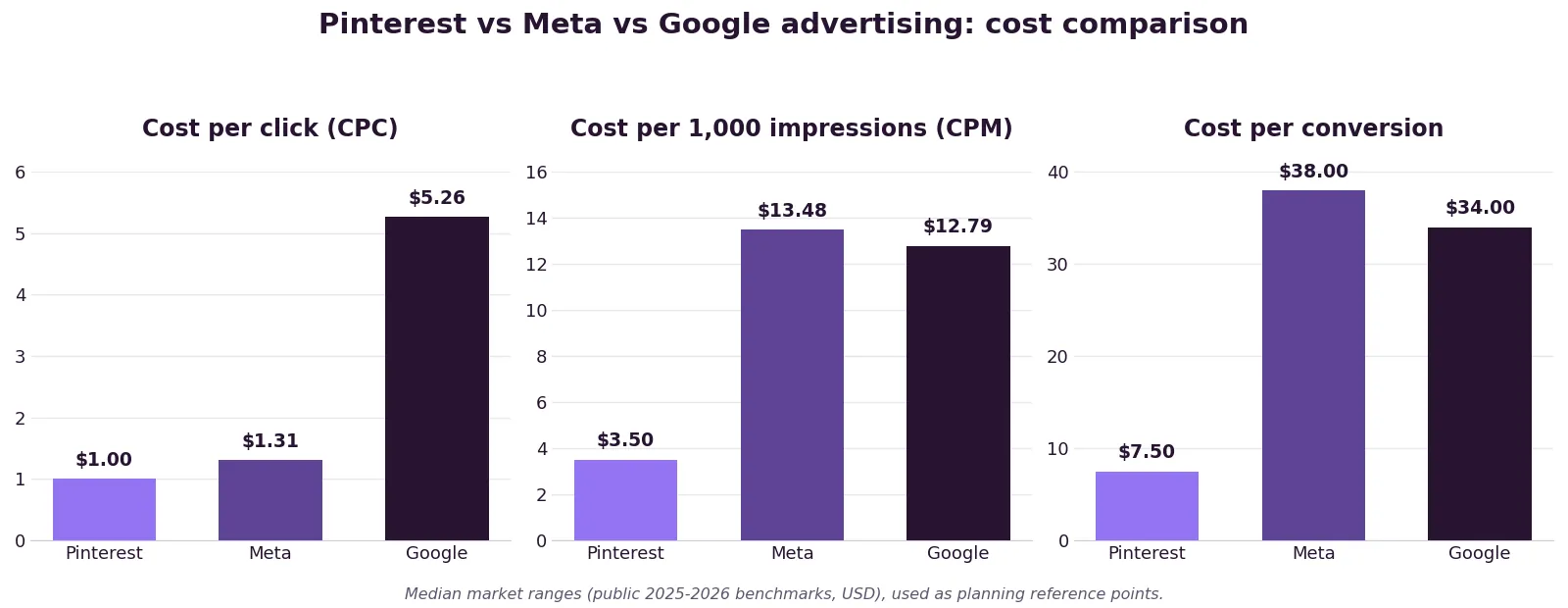
Visual comparison of median costs by platform. Pinterest shows the cheapest click and impression, as well as the lowest cost per conversion for retail.
The reading is clear. Pinterest offers the cheapest click and impression of the three platforms. Google remains the most expensive per click, in exchange for immediate intent. Meta sits in the middle for the click, with a high CPM linked to the density of its auction.
What a budget of less than $100 a day really allows
Take a concrete scenario for an online store investing $30 a day, about $900 a month. At a cost per click of $0.80, this budget generates nearly 1,125 monthly clicks. With a 2% conversion rate, that represents about twenty sales a month, at an acquisition cost of about $40.
This volume seems modest, but it remains precious: it feeds the pixel with conversion data. Once this base is built, the algorithm optimizes better and the cost per acquisition tends to drop. That is why we protect budget continuity rather than cutting delivery at the first quiet week.
The mistakes that waste a small budget
Two mistakes are enough to drain a tight budget without generating a sale.
Targeting traffic when you want sales
Choosing the traffic objective because it is cheaper per click is a false economy. Pinterest will then send people who click willingly, without purchase intent. The cost per click looks flattering, the cost per sale explodes. As soon as tracking allows it, optimize toward conversion, even if it means paying a bit more per click.
Neglecting tracking and the landing page
An attractive Pin that points to a slow, generic or inconsistent page wastes every paid click. The consistency between the visual, the promise and the landing page determines a large share of the conversion rate. We treat the landing page as an integral part of the campaign, not as a technical detail.
A well-structured small budget beats a poorly directed big one
Advertising on Pinterest rewards rigor more than budget size. An SMB that sets up its tracking, tightens its structure and polishes its Pins converts with amounts that other platforms swallow in mere impressions. Neglecting these foundations means paying for clicks that lead nowhere.
In 2026, visual search and AI-generated answers reward well-structured, well-described content. Brands that treat Pinterest as a search engine, with sharp visuals and consistent pages, get a head start over those that approach it as just another social network.
Launching a first structured test takes little: a clear objective, reliable tracking and a few good Pins. To build that base, discover our approach to digital advertising, or contact the team to validate together Pinterest's potential for your business.
Frequently asked questions about Pinterest advertising
What minimum budget do you need to launch a Pinterest campaign?
Pinterest imposes no minimum daily spend, which makes the platform accessible to small budgets. In practice, a credible test starts around $20 to $30 a day. This threshold leaves enough volume for the algorithm to learn and for the pixel to accumulate usable conversion data.
Pinterest or Meta: which platform should you choose with a small budget?
Pinterest offers a lower cost per click ($0.50 to $1.50 versus $0.70 to $1.92 for Meta) and a lower cost per conversion in retail. Meta keeps the advantage for finely targeting precise audiences, for its large audience and for established brands. For a visual product and a tight budget, Pinterest deserves a serious test before ruling out the option.
How long before you see conversions on Pinterest?
The decision cycle on Pinterest often spans 10 to 15 days, because people plan their purchases in advance. So avoid judging a campaign after a few days. A full month window gives a reliable reading, the time for the pixel to report deferred conversions.
Do you need an online store to advertise on Pinterest?
An online store helps a lot, especially for catalog sales campaigns connected to a product feed. A company without a catalog can nevertheless generate leads or traffic to service pages. The essential remains a clear, fast and consistent landing page aligned with the Pin.