


It's one of the most common questions we hear at a marketing agency. Anyone new to Google advertising wants to know if their budget is enough to run ads on this platform and, if so, how much they'll need to spend.
The answer is: IT DEPENDS!
How Much Does a Google Ad Actually Cost?
So many factors influence the cost of advertising on Google that it's nearly impossible to give one universal answer. But here's the good news: it's entirely realistic to run ads on almost any budget.
This guide walks you through every variable that affects the cost of a Google Ads campaign, so you can get a clearer picture of what budget you'll need for your specific situation.
We'll also share tools and tactics to help you estimate costs in your industry. And, most importantly, we'll give you expert tips to lower your campaign costs.
Now, let's get into what you actually came here for!
How Does Google Ads Billing Work?
First things first: Google charges for ads on a pay-per-click (PPC) basis. So if you run an ad and it gets zero clicks, your campaign costs you absolutely nothing.
That said, when you advertise on Google, you want clicks! The whole point is to drive potential customers to your website and guide them toward a specific action, such as signing up for a webinar, downloading an ebook, requesting a free consultation, or making a purchase.
What Is the Average Cost Per Click?
As you'd expect, the cost per click varies significantly from one industry to another. Some sectors compete fiercely on Google Ads, while others have much less presence on the platform. As a general rule, though, you can expect to pay between $1 and $2 per click across most industries.
Why Does Cost Per Click (CPC) Vary by Industry?
At its core, what drives CPC up is competition. If you're the only one bidding on a keyword, your clicks will be almost free. But when competition is high, CPC can rise quickly.
The value of a potential customer also differs from business to business. For example, an insurance company can afford to pay more per lead than a company selling shampoo.
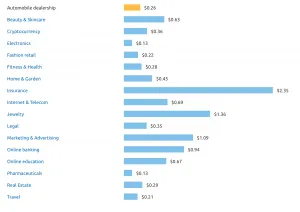
Industry-level CPC data gives you a much better sense of what you should expect to spend on Google Ads. Here are the CPCs for select industries in Quebec in 2020, according to SEMrush:
Fun fact:
Guess how much the keyword Houston maritime attorney costs in the United States?
Just a cool $1,304.65 to land in the top spot on the search results page!
Does Google Ads Give Me Control Over My Budget?
The good news is that Google Ads gives you complete control over your spending. You can adjust your budget in real time, at any moment. This flexibility is one of the platform's biggest strengths. You can even set a maximum amount you're willing to pay per click.
To start, Google will ask you to set a daily budget. If that budget is reached before the end of the day, your ads will be paused until the next day. You can also choose to run your ads at specific times of day. A restaurant, for example, could advertise on Google from 10 a.m. to noon and from 4 p.m. to 6 p.m., hoping to catch hungry prospects right before mealtimes!
The only reason Google might exceed your daily budget is during a period of unusually high traffic. For example, if your company offers a B2B service, Google might spend more on weekdays and less on weekends. Don't worry though: your average daily budget will still be respected over the course of the month.
The one thing you can't control is your competitors' maximum CPC bids. If they have deeper pockets and are willing to pay more per click, your ad delivery will take a hit.
However, in most industries, staying competitive is entirely possible. Why? Because most of your competitors have similar profit margins and can't afford to lose money on every click indefinitely.
Even in a competitive industry, there's always a strategy to get your ads in front of your prospects. We'll cover that later in the article.
How Do I Calculate My Average Cost Per Click on Google Ads?
You can find the average cost for any keyword or search term using a tool called Google Keyword Planner. Google offers this free platform to look up the CPC, search volume, and competition level for any of your potential keywords.
Keyword research is a crucial step in building a Google Ads campaign, since it directly impacts the relevance of your ads. In an ideal world, you'd find keywords with high search volume, low competition, and high purchase intent. That's easier said than done, but with experience and the right tools, it's very achievable!

How Does Google Ads Price and Position My Ads?
To truly understand what Google Ads will cost you, you need to understand how the platform works. You're probably familiar with Google search results: some ads appear at the top of the page, others at the bottom. Your ad position has a major impact on clicks, so it's completely normal for your CPC to fluctuate based on where you rank.
Google Ads uses an auction system to determine the cost and position of your ad. The auction starts the moment a user searches on Google. If their search term matches the keywords you're bidding on, your ad becomes eligible to show. You then compete with other advertisers targeting the same keyword. More specifically, both cost and position are determined by your Ad Rank.
How Does Google Calculate Ad Rank?
Ad Rank (i.e., your ad position) is influenced by two factors:
- The maximum bid you're willing to place for that keyword.
- The quality of your ad.

Your maximum bid is easy to understand and set, but ad quality is a bit more complex. Google assigns a Quality Score to each of your keywords, on a scale of 1 to 10, which directly influences your ad positioning.
Here are the 3 key factors that determine your ad quality:
Ad relevance
Google compares your ad against the keyword you selected, the user's search query, and the content of your landing page (the page you're sending users to). The stronger the alignment between these elements, the more relevant your ad appears to Google.
Expected click-through rate
This is essentially the probability that your ad will receive a click. Google uses your historical CTR (click-through rate) from past campaigns. The higher your expected CTR, the higher your quality score will be.
Landing page experience
Google's goal is to direct users to the best available information. It wants users to find what they're looking for and leave satisfied. After all, that's the main reason people use Google! Landing page quality is measured by several factors, including bounce rate and average time on page.
A strong landing page boosts your Quality Score and also guides visitors through the buying process. Because beyond the click, you want users to take a specific action on your site. Every landing page needs a clear goal or call to action (CTA).
How Do I Set My Google Ads Budget?
Start With a Test Budget
Running Google Ads on a fairly modest budget is completely realistic. Many people think you need thousands of dollars, but a few hundred dollars a month can be enough to get started.
Start small and adjust your budget based on results. That's the approach we recommend at Ursa Marketing. Begin with specific keywords and a narrow geographic area. Remember: you want keywords with solid search volume, low competition, and high purchase intent.
Of course, your campaign won't be perfect the day it launches. You'll need to test multiple concepts, and Google's algorithm will do the same on its end. Running tests within a campaign is essential for finding out what works best. The most common mistake on Google Ads is stopping campaigns too soon or failing to optimize after launch.
Build a Budget Using Projections
If you have a specific conversion goal for your Google Ads campaigns, you can estimate the budget you'll need.
Here's how:
- Take your conversion goal, divide it by your landing page's conversion rate, and you'll get the number of visitors (or clicks) needed to reach that goal.
You can also find your landing page conversion rate in Google Analytics.
- Once you have the required number of clicks, multiply that by your industry's average CPC to get a rough budget estimate.
Of course, this approach won't give you an exact number and won't tell you how long it will take to reach your conversion goal, but it gives you a solid ballpark for your Google Ads budget.
As a general rule, a minimum budget of $500/month is needed to see meaningful results with Google Ads. Once they start seeing a positive ROI, some businesses scale up to several thousand dollars per month.
How to Lower Your Cost Per Click on Google Ads
Set a Maximum CPC
There are several strategies to lower your CPC on Google. The simplest is to set a maximum CPC for your campaign. Here's how:
1. Select your campaign
2. Go to Settings
3. Click on Bidding
4. Set a maximum CPC bid limit
When you cap your CPC, both your ad delivery and ranking are affected. As mentioned earlier, Google determines ad placement through an auction. A lower maximum CPC means a lower Ad Rank, which makes you less competitive.
So when you decide to lower your maximum CPC, watch your campaigns closely and measure the impact. Your CPC will drop, but this tactic may ultimately prove less profitable.
Improve Your Quality Score
We know this may sound ambitious, but it's genuinely the best way to lower your CPC without hurting your positioning or reach.
When writing your ads, give people a compelling reason to click:
- Describe your product or service clearly, using the language your potential customers actually use.
- Highlight what makes your offer stand out from the competition.
- Most importantly, aim to be unique and create an emotional connection with your audience.
When writing your Google ads, make the most of the available character count. Create multiple ads and test different variations. Keep the best performers and repeat the process. We recommend applying a scientific method mindset when building your Google Ads campaigns.

Then, improve the quality of your landing page:
- Your service offering must be clear and straightforward. Visitors should immediately understand what you're offering.
- Your page must have a visible call to action (CTA).
There are plenty of other ways to improve your landing page, like adding testimonials, client logos, or scarcity techniques. But the most important thing is to put yourself in the customer's shoes and make the page as easy to navigate as possible.
Your keyword choices will also affect your Quality Score. Using longer, more specific keywords (long-tail keywords) helps you rank well. Google compares the user's search query to your keyword, and the closer the match, the higher your Quality Score.
Target Less Competitive Keywords
If you have a small budget and want to maximize your number of clicks, you can lower your CPC by targeting less popular keywords. Use tools like Google Keyword Planner, Moz Keyword Explorer, or Ubersuggest to get the CPC, search volume, and competition level for your keywords.
Yes, lowering your CPC matters, but there are many other factors that will determine the success of your Google campaigns!
For example, a prospect's location can affect their quality as a lead. A real estate company might be willing to pay more for a prospect in Montreal than one in a smaller market.
Device type can also affect lead quality. For example, one of our clients sells office furniture. After analyzing the data, we noticed that the majority of purchases came from desktop computers, not mobile. So we lowered our maximum CPC for users searching on a phone.
Finally, time of day can also affect user quality. If you run a clothing brand, you might want to focus your budget in the evenings, when most people are off work.
Advertising on Google: A must!
Think about it. When you start a purchasing journey, what's your first instinct? You go to Google and run a search. Not everyone uses Google in their buying process, but based on numerous studies, at least 75% of people do.
The reason so many companies advertise on Google is that those using the platform see a strong return on investment (ROI). And for good reason: Google Ads is one of the easiest platforms to reach interested, high-intent prospects. On top of that, Google gives you complete control over your budget. What more could you ask for?
If you have questions about how Google Ads works, reach out and we'd be happy to help.
Ursa Marketing also offers Google Ads training. Everything you need to become a true Google advertising pro!