


ChatGPT Ads strengthens its conversion campaigns and measurement tools
OpenAI continues to develop ChatGPT Ads with several new features that bring the platform closer to the standards of the major advertising platforms. The changes mainly affect conversion optimization, performance measurement and ad formats for e-commerce.
The main changes
- oCPC arrives for product campaigns: advertisers can now test optimized cost-per-click (oCPC) campaigns. They keep paying per click, but ChatGPT can optimize delivery based on the desired conversions. It is also possible to convert existing CPC campaigns into oCPC campaigns or to create several at once.
- Campaign tracking becomes more precise: new URL parameters automatically add campaign, ad group and ad identifiers to destination URLs. OpenAI is also adding integrations with Triple Whale and Hightouch, as well as more detailed diagnostic tools for conversion pixels.
- New formats are coming for e-commerce: OpenAI is notably testing a carousel that displays several products in a single ad, an evolution that brings the ChatGPT experience closer to the Shopping-style formats advertisers already know.
What it changes for advertisers
These changes mainly make it possible to move from a traffic-centric logic to a more performance-driven approach. oCPC notably gives advertisers the ability to optimize their campaigns based on conversions rather than simply trying to generate clicks.
The improved measurement tools are also important. Advertisers will be better able to track what happens after the click and compare ChatGPT’s performance with that of their other marketing channels.
For retailers, carousels and product-feed-based campaigns could also make ChatGPT more attractive as a product discovery and consideration environment.
It remains to be seen, however, whether ChatGPT will be able to offer advertisers the same level of volume, control and predictability as Google or Meta. For now, it is an emerging channel to watch closely, particularly for e-commerce brands.
Google extends its limited ad serving policy to all ads
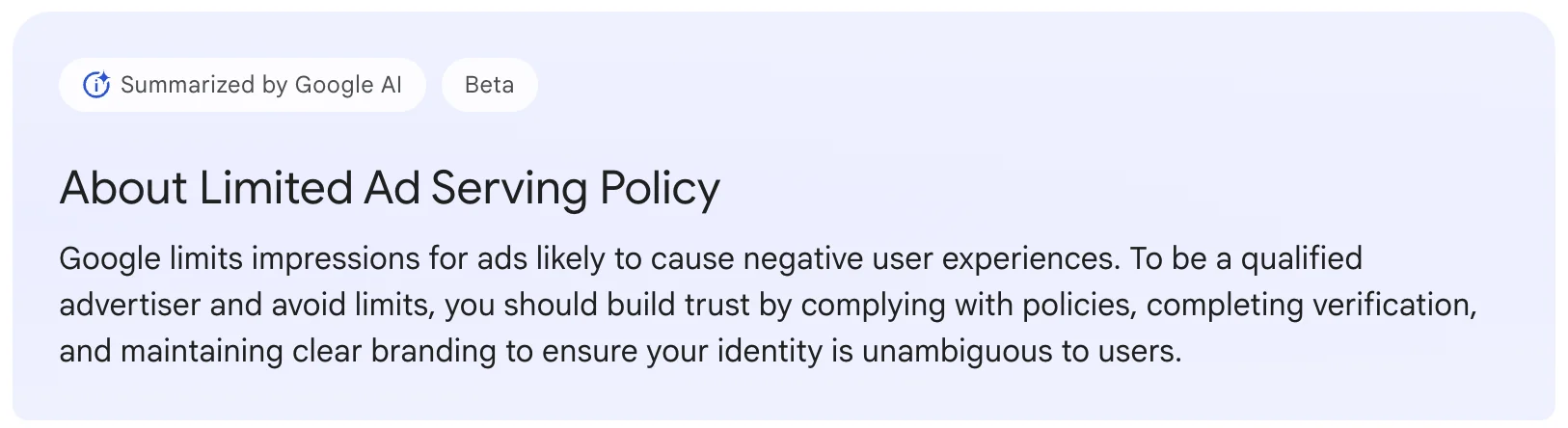
Google is extending its limited ad serving policy to better determine which advertisers can serve their ads without restriction. Qualification is based notably on account maturity, compliance history, advertiser verification, user reports and other signals related to account activity. The rollout will be gradual and should be completed by 2028.
The main changes
Rather than rejecting ads, Google can limit the impressions of advertisers who are not considered qualified in certain scenarios that present a higher risk of a negative user experience. Qualified advertisers are not subject to these limits in the situations covered by the policy.
To strengthen their qualification, advertisers are notably encouraged to complete their account verification, comply with Google’s advertising policies and maintain clear, consistent branding in their ads and landing pages.
What it changes for advertisers
This adjustment places more weight on account trustworthiness and history, in addition to compliance with advertising rules. Advertisers who do not meet the qualification criteria could see their impressions limited in certain contexts, particularly on Google Search.
Meta adds audiences dedicated to ad exclusion
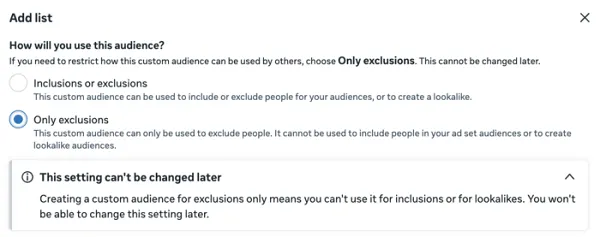
Meta is adding a new option to its advertising tools: exclusion-only audiences. This feature lets advertisers create lists of people who cannot be targeted by their ads, with no way to use that audience to include those same people in a campaign.
A new way to control who sees the ads
Advertisers can use these audiences to permanently exclude certain profiles, notably people who no longer wish to receive a company’s ads or those who cannot be targeted for legal or regulatory reasons.
The option can also act as a safeguard when creating campaigns, preventing an audience from being accidentally reintroduced into the targeting.
Concretely, what does it change?
The main benefit is to reduce wasted impressions and ad spend. A company can, for example, prevent its employees, certain customers or people already identified as irrelevant from receiving its ads.
This feature therefore offers additional control over targeting, which is particularly interesting for businesses that manage campaigns with several audiences or that must comply with certain privacy and compliance constraints.
This new option does not revolutionize Meta’s targeting, but it adds an extra level of control that can be especially useful for advertisers with complex campaigns.
In a context where every impression counts, better control over who to exclude can help reduce ad waste and improve campaign relevance.
Google accelerates the adoption of AI Max in Search campaigns
Google continues to integrate artificial intelligence into its Search campaigns. Starting September 1, certain campaigns already using automatically created assets or broad match may be automatically migrated to AI Max, without any manual action from advertisers.
An automatic migration to AI Max
Eligible campaigns will keep their current settings as much as possible, but some AI Max features will be enabled automatically.
For campaigns using automatically created assets, search term matching and ad personalization will notably be enabled. Campaigns using campaign-level broad match will benefit from search term matching.
What changes for advertisers
This transition means that some advertisers will have to deal with more automation in their Search campaigns, without having chosen to adopt AI Max themselves.
It will therefore be important to review campaigns after their migration to understand the newly enabled features and their potential impact on targeted queries, the ads served and performance.
The challenge for advertisers will be to strike the right balance between the automation offered by Google and the level of control needed to maintain a consistent search strategy. Closer monitoring of queries, creatives and results will therefore be essential as AI Max takes up more space.
Adapting to change
Between the arrival of new advertising features on ChatGPT, stronger controls at Google and Meta, and the growing automation of Search campaigns, advertising platforms keep evolving quickly. For advertisers, the challenge will be to stay on top of these changes while maintaining a strategy suited to their goals, their audiences and their business reality.
In a constantly evolving digital marketing environment, knowing how to adapt to change is becoming essential to keep campaigns performing and seize new opportunities.
Need help adapting your advertising strategy to these new features? Contact our team to discuss it.